Thailand's Complete Guide to Addressing Aging Populations
"The very policies that once stabilized a growing nation are now fueling a demographic squeeze."
Thailand's demographic landscape has undergone a radical transformation, shifting from a period of rapid expansion to a modern era defined by a shrinking workforce and a rapidly aging citizenry.
* Government-sponsored family planning programs successfully lowered growth rates between the 1960s and 2015. * The nation is facing a significant demographic shift, with the median age reaching 41 years. * A contracting working-age population presents a long-term challenge to economic stability. * Urbanization remains a dominant trend, concentrating a large portion of the population in metropolitan regions.

How Did Thailand Manage Its Population Growth Trajectory?
In a quiet Bangkok office, a policymaker sighs while running a hand over yellowed paper from decades past.
A policymaker in a Bangkok office looks over a stack of census reports from decades ago, noting the sharp decline in birth rates compared to the mid-century surge. The transition from a high-growth society to a stabilized one was a deliberate result of state-led initiatives.
In the 1960s, Thailand experienced a massive spike in population growth, a common trend in developing nations during that era. However, the government introduced successful family planning programs to manage this expansion.
These initiatives worked so effectively that the growth rates seen in the mid-20th century were drastically reduced by the time the nation reached a stabilized state around 2015.
While these programs prevented overpopulation and resource depletion, they also set the stage for the current demographic imbalance. The success of controlling growth has transitioned into a new challenge: managing a society where the younger generation is much smaller than the one that preceded it.
But how does this look on the ground today?

What does Thailand's population look like right now? A traveler walks through a bustling market in Chiang Mai, noticing that while the streets are full, the demographic makeup of the crowd feels distinctly different than it did twenty years ago. The current numbers tell a story of a nation that has reached a plateau.
According to World Bank data, Thailand recorded a total population of 71,619,863 in 2025. This population is equivalent to 0.86% of the total world population.
The demographic structure shows a clear shift toward an older population. The median age in Thailand is 41 years. This figure indicates a society that is no longer "young" in the traditional sense, but is instead moving into a mature phase of development.
This shift toward maturity is not just a statistic on a page; it is a fundamental change in how the country functions. This leads to a looming crisis that many are only beginning to feel.
How will aging and dependency ratios affect us? An elderly man sits on a park bench in Bangkok, watching a group of much younger tourists pass by, highlighting the widening gap between generations. This visual represents the growing "dependency ratio" that economists are watching closely.
The most pressing issue is the increasing proportion of the population aged 60 and over. As the number of elderly citizens grows, the number of working-age individuals available to support them and drive the economy shrinks.
The contraction of the working-age population is a projected long-term economic challenge. Between 2010 and 2040, the labor force is expected to tighten significantly.
This shift creates a "sandwich generation" where middle-aged adults must balance the needs of their children and their aging parents simultaneously. But as people move to the cities to find work, the problem takes on a new shape.
Urbanization and Modern Living Conditions
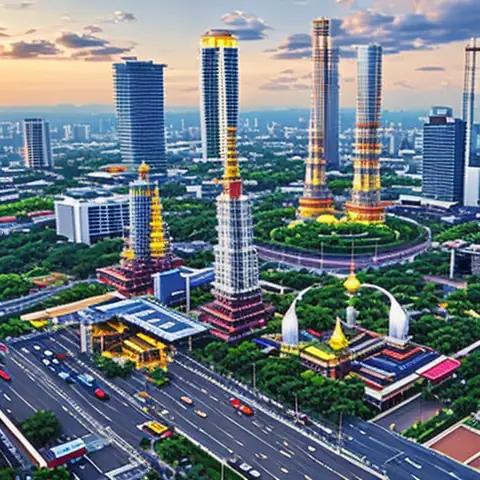
The neon lights of a Bangkok skyscraper reflect off a crowded street where thousands of commuters move through the metropolitan area every evening. This density is a hallmark of Thailand's modern demographic distribution.
Urbanization has fundamentally reshaped how the country lives and works. In 2010, the urban population—principally in the Bangkok Metropolitan Region—was 45.7 percent of the total population according to the National Economic and Social Development Board (NESDB).
As of 2026, 54.27% of the population is urban, representing 38,836,778 people. This concentration of people in cities drives economic productivity but also places immense pressure on infrastructure, housing, and healthcare systems in metropolitan hubs.
This massive shift toward city life changes the economic math for everyone involved.

Economic Context and Modernization Indicators
A young professional in a high-rise office uses a smartphone to manage investments, representing a highly connected and modern workforce. Despite demographic headwinds, the economy continues to move forward through technological integration.
The economic landscape remains dynamic even as the population structure shifts. According to World Bank data, Thailand recorded GDP growth of 2.4% in 2025.
This growth occurs against a backdrop of a changing labor market that will eventually require higher productivity per person to offset the smaller workforce.
Digital connectivity is a key factor in this modern economy. According to World Bank data, Thailand recorded a share of internet users of 90.9% in 2024.
This high level of connectivity suggests that while the workforce may be shrinking, the nation is well-positioned to leverage automation and digital tools to maintain economic momentum.
| Demographic Metric | Value/Statistic |
|---|---|
| Total Population (2025) | 71,619,863 |
| Median Age | 41 years |
| Urban Population Percentage (2026) | 54.27% |
| Internet Penetration (2024) | 90.9% |
How to Navigate the Changing Demographic Landscape
I remember sitting in a small cafe in Bangkok last year, watching the mix of retirees and young tech workers, and wondering how the city would handle this shift. It became clear that understanding the transition requires a clear perspective on the moving parts.
To understand the trajectory, one must look at the specific drivers of change. Here is a breakdown of the demographic evolution:
- Growth Control Phase: Successful family planning in the late 20th century stabilized the population but lowered the birth rate.
- Aging Transition: As the previously large youth cohorts age, the median age rises, creating a higher dependency ratio.
- Urban Concentration: Movement toward metropolitan hubs like Bangkok creates high density and economic power but strains local resources.
- Digital Integration: High internet penetration allows for productivity gains that can offset a shrinking labor force.


Comments 0